

Schools are high-risk environments for airborne transmission, where bioaerosols can remain suspended for hours and travel between classrooms. At the same time, new CDC recommendations and ASHRAE Standard 241 set ambitious "clean air" targets without indefinitely overburdening HVAC systems. Discover how UVC air disinfection—in-duct and standalone units—helps schools effectively manage bioaerosol risks while controlling energy and costs.
Schools are uniquely vulnerable to airborne disease transmission. High occupancy, prolonged exposure times, and vocal activities such as talking or singing create ideal conditions for bioaerosol generation — microscopic airborne particles that can contain infectious agents like cold viruses (Rhinoviruses), flu viruses (Influenzaviruses), Respiratory syncytial virus (RSV), and SARS-CoV-2. These particles can remain suspended for hours and travel across classrooms, enabling secondary transmission even when direct contact is limited.

Traditional ventilation and filtration strategies play a key role in maintaining healthy indoor air quality (IAQ). However, they come with trade-offs. Increasing outdoor air ventilation can reduce contaminant concentration but also significantly raises heating and cooling energy loads, particularly in climates with extreme temperatures. Similarly, upgrading to high-efficiency filtration (MERV 13 or higher) improves particle removal but adds pressure drop to the system, increasing fan energy use and maintenance requirements.
As energy efficiency targets tighten across North America, schools face a difficult balance: maintaining good IAQ while keeping operational and environmental costs manageable.
The Center for disease control (CDC), through the National Institute for Occupational Safety and Health (NIOSH) recommends 5 or more air changes per hour, or its equivalent with air cleaning systems, defined in terms of equivalent air changes per hour1. The recommended 5 eACH is a “rule of thumb”; actual eACH could vary based on the volume of air as well as the number of occupants.
Following the COVID-19 pandemic, the American Society of Heating, Refrigerating and Air-Conditionning Engineers (ASHRAE) published the ASHRAE Standard 241 – Control of Infectious Aerosols (2023). This standard establishes the framework for reducing airborne transmission in buildings, including schools2. It emphasizes achieving an “Equivalent Clean Airflow Rate” (ECAi) through a combination of ventilation, filtration, and air cleaning technologies — explicitly recognizing in-duct and recirculating UVGI systems as compliant air-cleaning methods. Standard 241 also factors in the number of occupants in a space as potential sources of contamination. Hence, the recommended ECAi values are expressed in terms of CFM of “clean” air per occupancy rate of indoor spaces.
Several U.S. states (e.g., California, New York, Illinois) and Canadian provinces (notably British Columbia and Ontario) are now referencing ASHRAE 241 or its principles within emerging IAQ guidelines and funding programs for school air upgrades. These policies highlight UVC systems as a verified, energy-efficient option for reducing airborne infectious risk when HVAC retrofits or high outdoor air rates are impractical.
Furthermore, some components of the HVAC system themselves have been shown to affect indoor air quality, such as cooling coils, which are often source of microbial growth (biofilm). Using UVGI systems on the cooling coils has been shown to prevent biofilm accumulation, but also reduced negative workplace associated health symptoms3. Morevoever, keeping the cooling coils clean with UVGI has also shown to improve energy efficiency of the cooling coils, through both a decrease in pressure drop caused by the microbial growth, as well as improving the energy transfer of the fins4.
Ultraviolet germicidal irradiation (UVGI) uses short-wavelength ultraviolet light (typically at 254 nanometers) to inactivate microorganisms by damaging their DNA or RNA, as well as surface proteins. Two types of applications can be readily implemented in school environments, as an adjunct part of a complete IAQ solution to address bioaerosols, but also other airborne pollutants:
Both technologies directly target airborne microorganisms and bioaerosols, reducing infectious risk without the energy burden associated with large increases in outdoor air or high-pressure-drop filtration for in-duct systems.
When properly designed, in-duct UVGI systems can deliver the required clean air with minimal electrical power. The energy consumption of a UVGI system can be much lower than that of additional mechanical ventilation needed to achieve the same level of airborne contaminant reduction.
In-room systems also have advantages, not being dependent on the HVAC system, and to be able to reduce the bioaerosols load more efficiently locally, though at the cost of fan noise.
Key advantages include:
For standalone UV air purifiers, performance depends on room size and airflow rate. Many commercial models can provide enough clean air to supplement existing HVAC systems and providing localized reduction of bioaerosols in high-occupancy areas like classrooms or staff rooms.
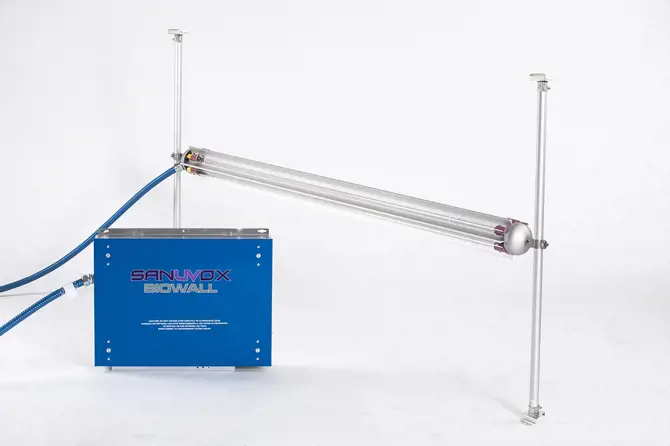
Sanuvox UVGI system are designed and engineered to efficiently address IAQ issues, based on the type of built environments, and custom fitted to each application. Solutions range from in-duct UV system, which are specified according to the existing HVAC system, to provide sufficient irradiation on the air flow or on HVAC surfaces (cooling coil) and inactivate biological contaminants.
In-duct air disinfection systems (e.g. BioWall and Quattro) are sized based on the UV systems intensity output, as well as duct size, airflow and airspeed, air temperature, reflectivity of the ductwork material and any other HVAC characteristics that may affect the UV output. With that information, a qualified Sanuvox team member will be able to size (with a proprietary sizing software) and recommend the proper system to reach the required UV dose on the airflow and properly inactivate common airborne contaminants of occupied spaces. For schools, recommended UV dose is often linked to viral respiratory pathogens, as many of these have shown transmission by the bioaerosol route.
Standalone systems (in-room air purifiers), such as the M8, have been designed to provide an efficient UVC dose on the air flow, based on the inactivation of common human pathogens that have been shown to be transmitted through bioaerosols. For example, the M8 unit provides a UV dose of almost 6 mJ/cm2 on the air at its maximum airflow. Some standalone units are also equipped with filters (Merv 8-9, as well as HEPA filters). The combined action of both the UVGI dose and the filters drastically reduces any bioaerosols that would travel through the unit. The filters also contribute to reducing other non-biological airborne pollutants, such as dust and particulates.
UVGI systems for HVAC cooling coils can also be sized properly with the use of Sanuvox’s proprietary software, to provide sufficient UV dose on the coil to prevent biofilm growth.
To ensure performance and safety:
1 https://www.cdc.gov/niosh/ventilation/prevention/Aim-for-5.html
3Menzies D, Popa J, Hanley JA, Rand T, Milton DK. Effect of ultraviolet germicidal lights installed in office ventilation systems on workers' health and wellbeing: double-blind multiple crossover trial. Lancet. 2003 Nov 29;362(9398):1785-91. doi: 10.1016/S0140-6736(03)14897-0. PMID: 14654316., https://pubmed.ncbi.nlm.nih.gov/14654316/
4Adam R, Deok-Oh W, Arpan G. An energy efficiency and cost analysis of utilizing high-intensity profile UVC systems on air handling unit under cool-humid climate. Building and Environment, Volume 265, 2024,111989, ISSN 0360-1323, doi.org/10.1016/j.buildenv.2024.111989. https://www.sciencedirect.com/science/article/abs/pii/S036013232400831X